
How Lab-Grown Emeralds Are Made: The Hydrothermal Method
If you love emerald green, you’ve probably noticed how much the price of natural emeralds can vary.
Lab-grown emerald offers another way to enjoy that unmistakable green color. One of the methods used to grow it is called hydrothermal growth—and it’s the method used for our lab-grown emerald color options.
So how does it work, and what does it mean for the jewelry you’re choosing?
What is hydrothermal growth?
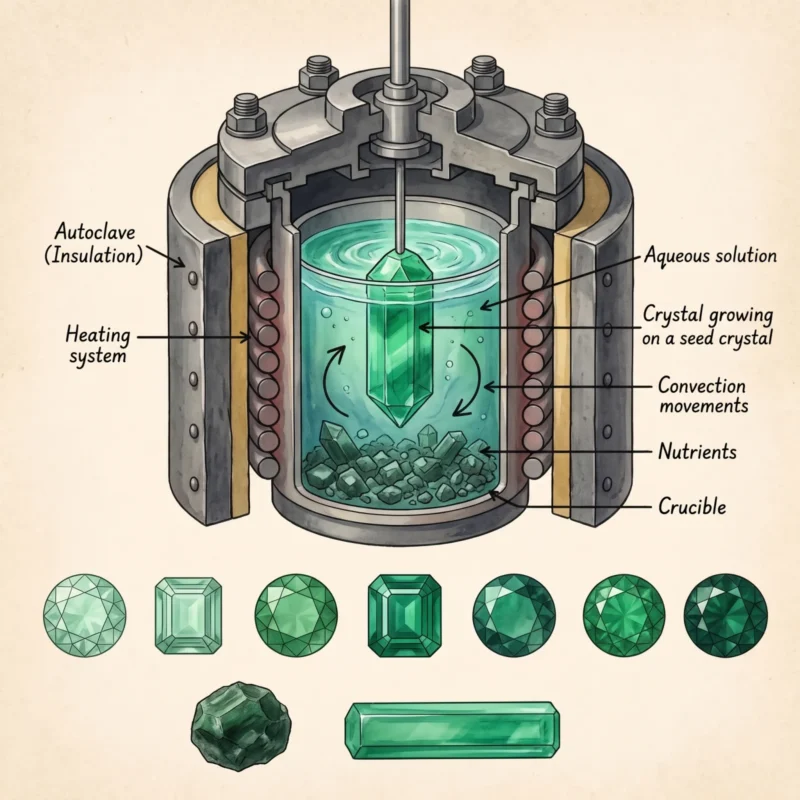
Hydrothermal growth uses hot, pressurized water-based solutions to grow crystals.
Instead of melting all the ingredients into a liquid, the process dissolves the necessary materials in a special solution inside a sealed chamber. Under carefully controlled conditions, those materials move through the solution and gradually build a crystal on a seed.
It’s a way of growing an actual crystal, not a way of coating glass green or dyeing an imitation stone.
The process uses heat, pressure and time. It recreates some aspects of the environments in which minerals can grow naturally, but a lab-grown emerald is still different from a mined one in its origin and possible growth features.
Is a hydrothermal emerald actually emerald?
Yes—when the material being grown is emerald, the result is lab-grown emerald, a green variety of the mineral beryl.
Lab-grown emerald and natural emerald have the same defining mineral identity. Their origins are different, and individual stones may differ in inclusions, growth patterns or other characteristics.
This is also why it matters to know what a green stone is made of. Not every emerald-looking crystal is emerald. Some other green stones are entirely different materials.
Why choose hydrothermally grown emerald?
For many people, the attraction is simple: enjoying a beautiful emerald-green gemstone without paying primarily for the natural rarity of a high-quality mined emerald.
Lab-grown emerald can give you appealing choices in:
- Color. Explore the green shade that works best with your skin tone, jewelry design and personal taste.
- Clarity. Some lab-grown emeralds have an attractive, open appearance; others may show internal features. Neither should be assumed without seeing the actual stone.
- Budget. A lab-grown option can leave more room for the center-stone size, metal or setting you prefer.
Hydrothermal growth doesn’t guarantee that a stone is flawless, brighter than a natural emerald, or available in every size. You still want to judge the finished gemstone on its own appearance.
Which IMIYOO emeralds are hydrothermally grown?
Our Zambia Emerald and Colombia Emerald options are both hydrothermally grown lab-grown emerald (beryl).
The names describe different green color styles in our collection. They do not mean the stones were mined in Zambia or Colombia.
If you’re choosing between the two, focus on the color you prefer rather than treating either name as a statement about geographic origin. Have a shade or size in mind? Share a reference with us, and we’ll check the options for your design.
Is hydrothermal emerald better than flux-grown emerald?
They’re two different ways to grow lab-grown emerald. Hydrothermal growth uses a water-based solution under heat and pressure. Flux growth uses a hot flux that dissolves the ingredients as a crystal forms.
Neither method, by itself, tells you which finished emerald will look better. Color, transparency, cut, inclusions and how the stone looks in your setting matter more to most jewelry buyers.
And neither growth method makes a lab-grown emerald a naturally mined stone.
Will it be durable enough for a ring?
Emerald has a Mohs hardness of about 7.5–8, whether it formed naturally or in a laboratory. That’s reasonable scratch resistance, but it doesn’t make an emerald impact-proof.
If you plan to wear an emerald ring often, consider a setting that protects the corners and doesn’t leave the stone too exposed. Gentle cleaning with mild soap and lukewarm water is a sensible starting point. Because individual emeralds can have internal features or treatments, avoid steam or ultrasonic cleaning unless a qualified jeweler confirms they’re safe for your particular stone.
Frequently asked questions
Is hydrothermal emerald made by coloring glass?
No. The hydrothermal process grows emerald crystals from dissolved ingredients under controlled conditions.
Is a lab-grown emerald identical to a natural emerald?
It has the same defining mineral identity, but a different origin. Individual stones can also have different growth features and appearances.
Does hydrothermal growth guarantee a flawless stone?
No. Clarity still varies, so it’s worth reviewing the stone and the cut you’re choosing.
Can I request a particular green shade or shape?
Absolutely. Tell us what you’re picturing, and we’ll check what’s available for your custom jewelry design.


